The Temple of Vesta: From the Early Kingdom under Numa to Today: A historical fiction novelist's guide to the archaeology of the Aedes Vestae and Rome’s sacred hearth fire
When people search “What is the Temple of Vesta," they usually get a pretty straightforward answer along the lines of, “It was a circular building in the Roman Forum where the Vestal Virgins kept the goddess’s sacred fire burning.”
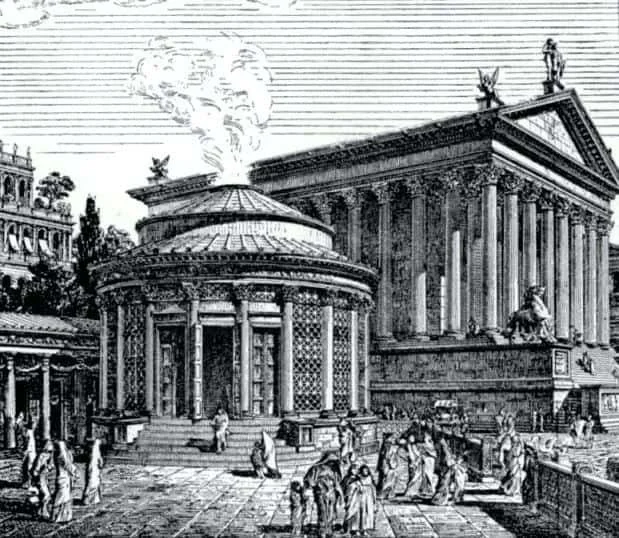
The Round Temple of Vesta in the Roman Forum (the temple of Castor and Pollux behind)
But after years of researching the Vestal Order for my novels — and walking the ground of the Roman Forum myself, trying to stand exactly where a Vestal would have stood — I know that this “circular building” was not one building. The temple, then and now, was the accumulated memory of every building before it that burned down and was raised from the ashes. By the last rebuild, at least half a dozen had come before.
This article walks through that architectural history in the order it happened, but it also walks through the archaeological history — who dug it up, when, and what they found. Not many Bothans died to bring us this information, but it’s just good manners to give credit where credit is due. I’ve also included some of the historical highlights that accompanied each phase of the temple’s life. Because the temple is really a layered record of excavation and history.
I've written this for readers who found this page by searching things like "when was the Temple of Vesta built," "how many times was the Temple of Vesta destroyed," or "what happened to the Temple of Vesta." So pour yourself a cup of coffee and settle in for a few minutes to learn about this amazing structure.
Where the Temple of Vesta stands, and why its location matters
The temple sits at the southeastern end of the Roman Forum, at the foot of the Palatine Hill, wedged between the Regia (the old headquarters of Rome's chief priest and the house where it’s said King Numa lived), the House of the Vestal Virgins (the Atrium Vestae) where the priestesses actually lived, and the spring of Juturna (a healing spirit). This cluster of buildings — Regia, temple, and Vestals' house — formed the religious heart of the Roman state for over a thousand years. It was also the backdrop to some of the most dramatic and important moments in Rome’s history, some of which I’ll touch on.
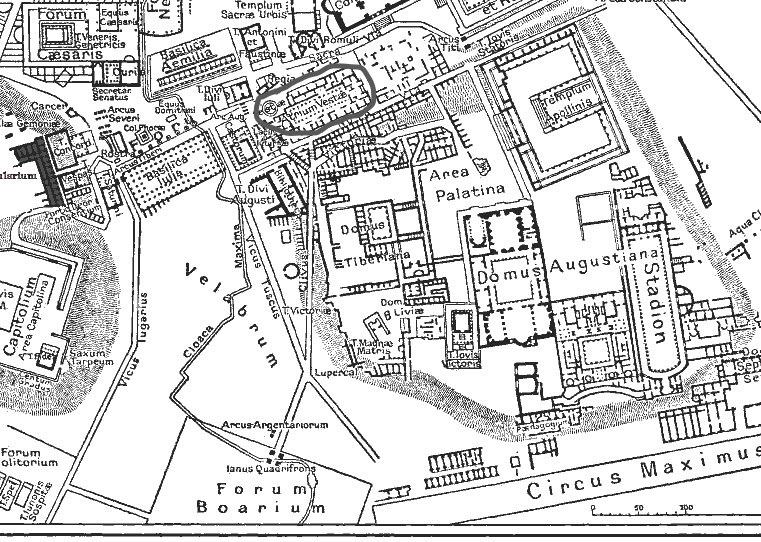
See the gray circle? That’s around the circular temple (at 9 o’clock) and the rectanglar House of the Vestals.
Architecturally, Vesta’s temple was somewhat unusual: it was round, not rectangular like almost every other Roman temple, with a domed roof. In the center of the roof was an oculus through which the smoke from Vesta’s fire escaped.
Ancient writers, and the historicans and archaeologists who later studied their accounts alongside the physical remains, agreed this circular shape was meant to recall the primitive round huts of early Rome. This was a deliberate architectural fossil that preserved the memory of the first Roman homes long after Romans themselves lived in rectangular houses. Yet some ancient writers, like Festus and Plutarch, suggest the temple was round to represent the earth, which sustains life, or even the universe and the “fire” at its center.
Vesta’s temple also stands out for another reason. Rather than housing a statue of a deity, its round interior (the cella) held only the sacred hearth, where a fire was kept burning day and night. Romans believed the fire's extinction was an omen of disaster for the city itself — it was necessary to maintain the pax deorum, or peaceful accord with the gods. If the fire went out, it was, to put it bluntly, lights out for Rome.
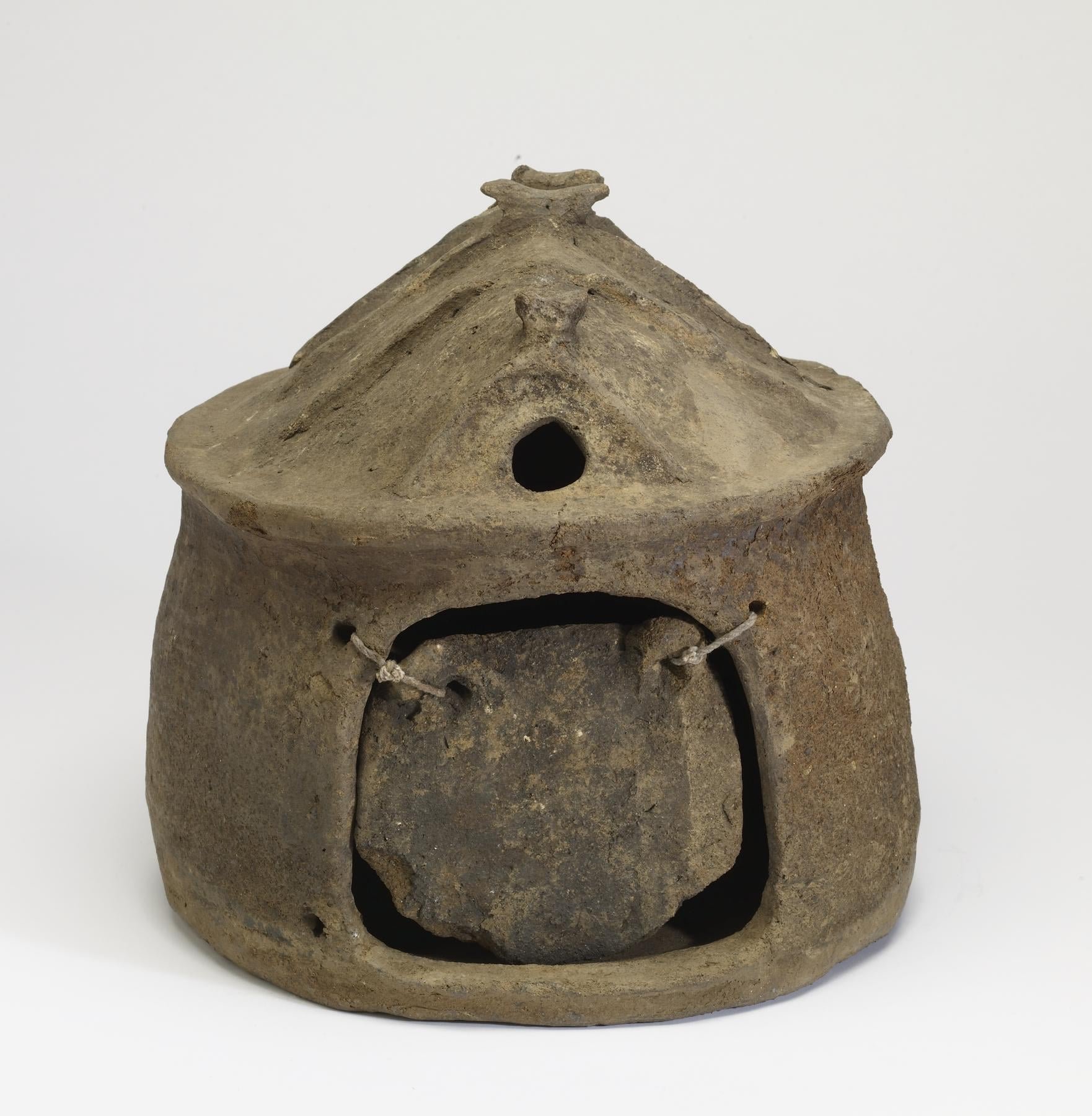
An 8th century urn in the shape of a Roman hut
Phase one: the beginning (traditionally 8th–7th century BCE)

A coin depicting King Numa in the foreground
Roman writers believed that Numa Pompilius, Rome's legendary second king, founded both the official order of the Vestal Virgins in Rome (although the priesthood did exist elsewhere, such as in Alba Longa and Bovillae, before Rome’s founding) and the first temple.
According to this tradition, the earliest shrine was a round wattle-and-daub hut with a thatched straw roof. This was essentially the same humble construction as an ordinary early Roman house (as already mentioned), though reserved for a sacred fire instead of a family hearth. For decades this was regarded as pious legend rather than archaeological fact, since nothing from an 8th or 7th-century-BCE straw hut could survive thousands of years of rebuilding on the same spot.
Yet legends often spring from truth. Excavations in the wider Atrium Vestae complex have in fact revealed traces of a hut dating to the mid-8th century BCE, which some archaeologists have proposed as the earliest residence of Rome's priestesses. This confirms that people were living and practicing religious activity on this very spot right around the time that Roman tradition claims the city was founded.
And this gives us the first of many examples where Rome’s legends and history intersect in a way that is unique to the eternal city. I’ve combined these - legend, mythology and history - in my trilogy The First Vestals of Rome which is set during this period and includes not just Romulus (Rome’s founder) and Numa, but the legendary Vestals (Rhea Silvia, Tarpeia, Amata and more within the pages) that are assigned to this time.
Phase two: destroyed by the Gauls, 390 BCE
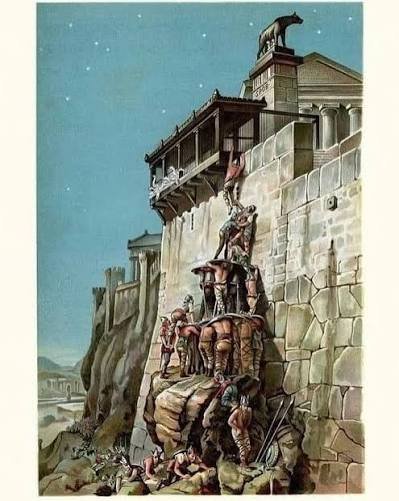
The Gauls sneak up the Capitoline Hill to invade Rome
The temple's first attested destruction came when those troublesome Gallic forces sacked Rome in 390 BCE, burning much of the city, including the Vesta precinct.
The ancient historian Livy records a gripping detail: after the Gauls withdrew, the Vestals were found to have rekindled the sacred fire among the ruins almost immediately. Despite the destruction of the temple, Vesta’s flame — and by extension, Rome's fortunes — had survived. This is a good example of why the temple's history isn't just an architectural timeline. Every rebuilding was, to the Romans, an act of resilience, duty and piety.
Phase three: fire, and the blinding of Metellus, 241 BCE
The most famous fire in the temple's Republican history struck in 241 BCE. According to the poet Ovid, flames engulfed the building so wildly that the Vestals were unable to retrieve the sacred objects kept inside, including the Palladium. The Palladium was an ancient statue of Athena/Minerva that the Romans believed Aeneas had carried out of burning Troy centuries earlier, and which they regarded as one of the pignora imperii or sacred relics that guaranteed Rome's survival.
According to the story, one Lucius Caecilius Metellus, the Pontifex Maximus at the time, braved the flames and entered the burning temple himself to save it. Yet because it was against custom for men to enter the temple, and because no good deed goes unpunished, brave Metellus was blinded by the flames (though, happily, his sight was later said to be miraculously restored).
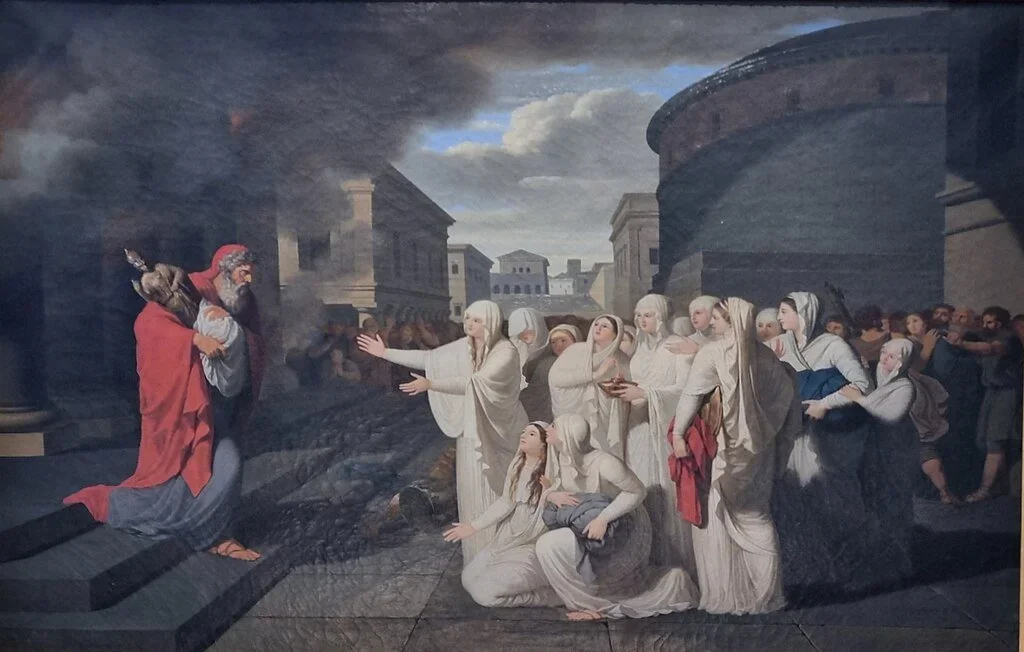
Mettelus saving the Palladium from the burning Temple of Vesta. If you look at the Vestals, you can see one is holding a flame from Vesta’s fire, and others have various items or perhaps important documents wrapped in fabrics
A further, though less dramatic, fire is recorded in 210 BCE.
Phase four: Julius Caesar's body, and the temple as backdrop to the fall of the Republic, 44 BCE
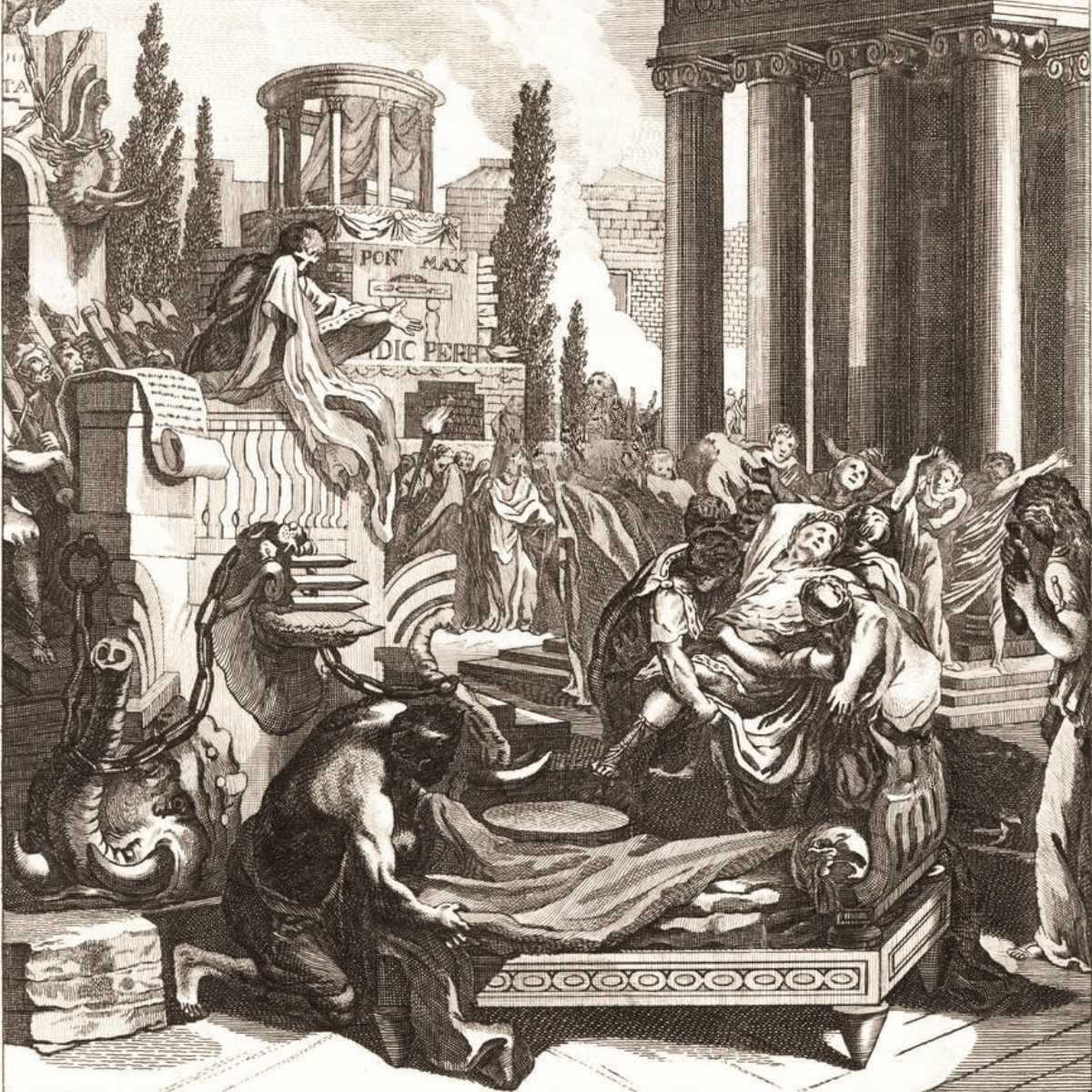
Here’s an illustration of Antony giving his famous funeral speech from the Rostra
By this period, the temple of Vesta was a proper white marble temple. And while it wasn’t destroyed during this period, something else was beginning to fall apart. The Roman Republic.
Following the assassination of Julius Caesar on the Ides of March in 44 BCE, his body was brought into the Roman Forum for Marc Antony to deliver his famous funeral speech. After being worked up into a proper frenzy by Antony’s oration, the crowd seized Caesar’s body and tried to carry it up toward the Capitoline Hill to cremate him there. When the priests blocked their route, they turned back down the Via Sacra and improvised a funeral pyre directly in front of the Regia — Caesar's own official headquarters as Pontifex Maximus — using benches, furniture, and anything else they could find. That spot sat immediately beside the Temple of Vesta and the House of the Vestal Virgins.
So Caesar was cremated on Vesta's doorstep, quite possibly with flame from the sacred fire. After all, Julius Caesar had a unique relationship with the Vestal Order. After being added to Sulla’s dreaded proscription list decades earlier, the Vestal Virgins petitioned for Caesar’s pardon. It was a request from a powerful and respected order of women, and Sulla could not refuse it.
A few years later, the Temple of the Deified Julius (Divus Iulius) was built on that exact site, permanently absorbing part of the old Forum square and sitting adjacent to the Temple of Vesta. I find this corner of the Forum to be quite emotionally charged. It’s hard not to stand on the site, so close to Vesta’s temple and so close to that famous cremation, without feeling the winds of history blow by.
Phase five: Octavian takes Antony’s will from the temple in 32 BCE, and reorganizes the precinct as emperor, 12 BCE
In 32 BCE, Octavian (Julius Caesar’s adopted son and heir) and Rome were at de facto war with Antony and Cleopatra in Egypt. But Octavian needed a good reason to declare official war - and he knew the scandalous contents of Antony’s will would give him that reason. There was just one problem. Antony’s will, like the wills of many powerful men, was in the sacred safekeeping in the temple of Vesta. It would be a sacrilege to take it.
And here we see one of the most politically significant moments in the history of the Vestal Order (and one I dramatize in Brides of Rome, book one in my trilogy The Vesta Shadows, which takes place during this time period). Defying custom, Octavian entered the temple and took the will. And apparently all he received in response from the Vestalis Maxima Occia was a slap on the wrist along the lines of, “Well, if you’re determined to do it, I won’t stop you.”
It’s pretty obvious that the big drama happened behind the scenes. It’s hard to imagine that Octavian would’ve committed this act on impulse or without knowing how it would play out - he was a strong tactician, after all. More than likely, the chief priestess Occia had chosen her side. And after Octavian defeated Marc Antony and became Rome’s first emperor, she and the Vestal Order reaped the rewards.
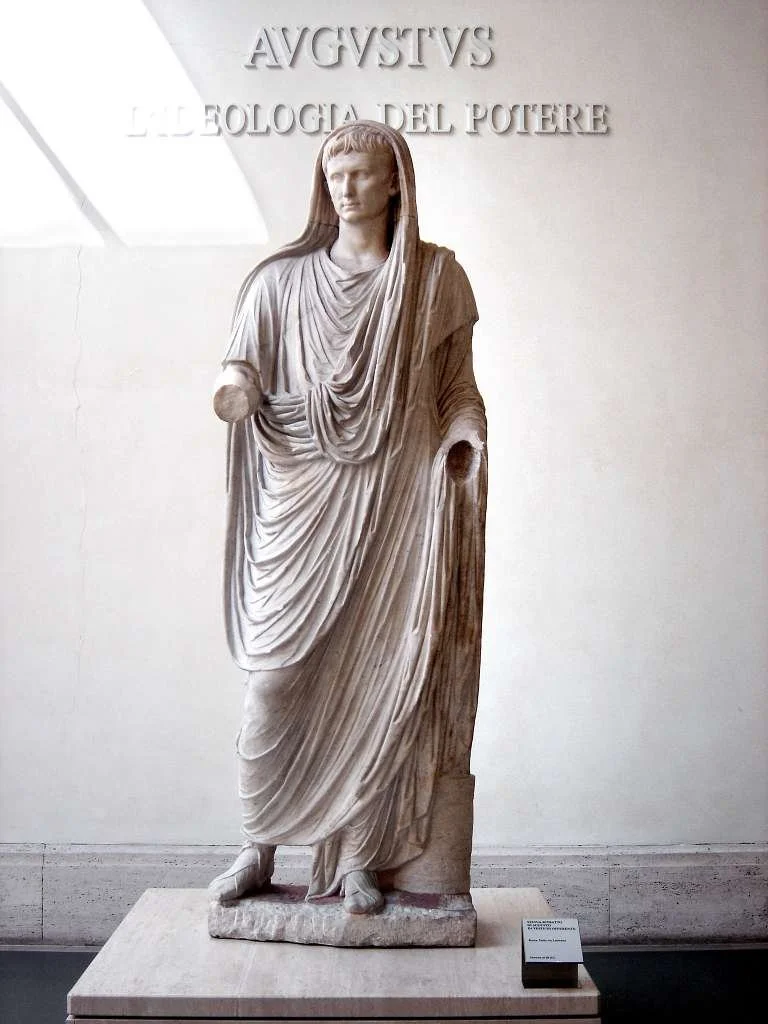
A statue of Augustus as Pontifex Maximus. He and the Vestalis Maxima of the day, Priestess Occia, would have worked closely together for much of their lives
As Rome’s chief priest, Augustus did things differently. Rather than moving into the forum, as previous chief priests did, he kept his own house on the Palatine Hill and dedicated a shrine to Vesta near it. (Unfortunately, we don’t know much about that shrine’s appearance, other than a possible depiction of it on a later coin struck under Tiberius).
He then donated the old Domus Publica — the official priestly residence beside the Vesta precinct in the Forum — to the Vestals themselves, enlarging their house. It would be one of many riches, favors, privileges, legal rights, monies and honors he would bestow upon the temple and the priestesses.
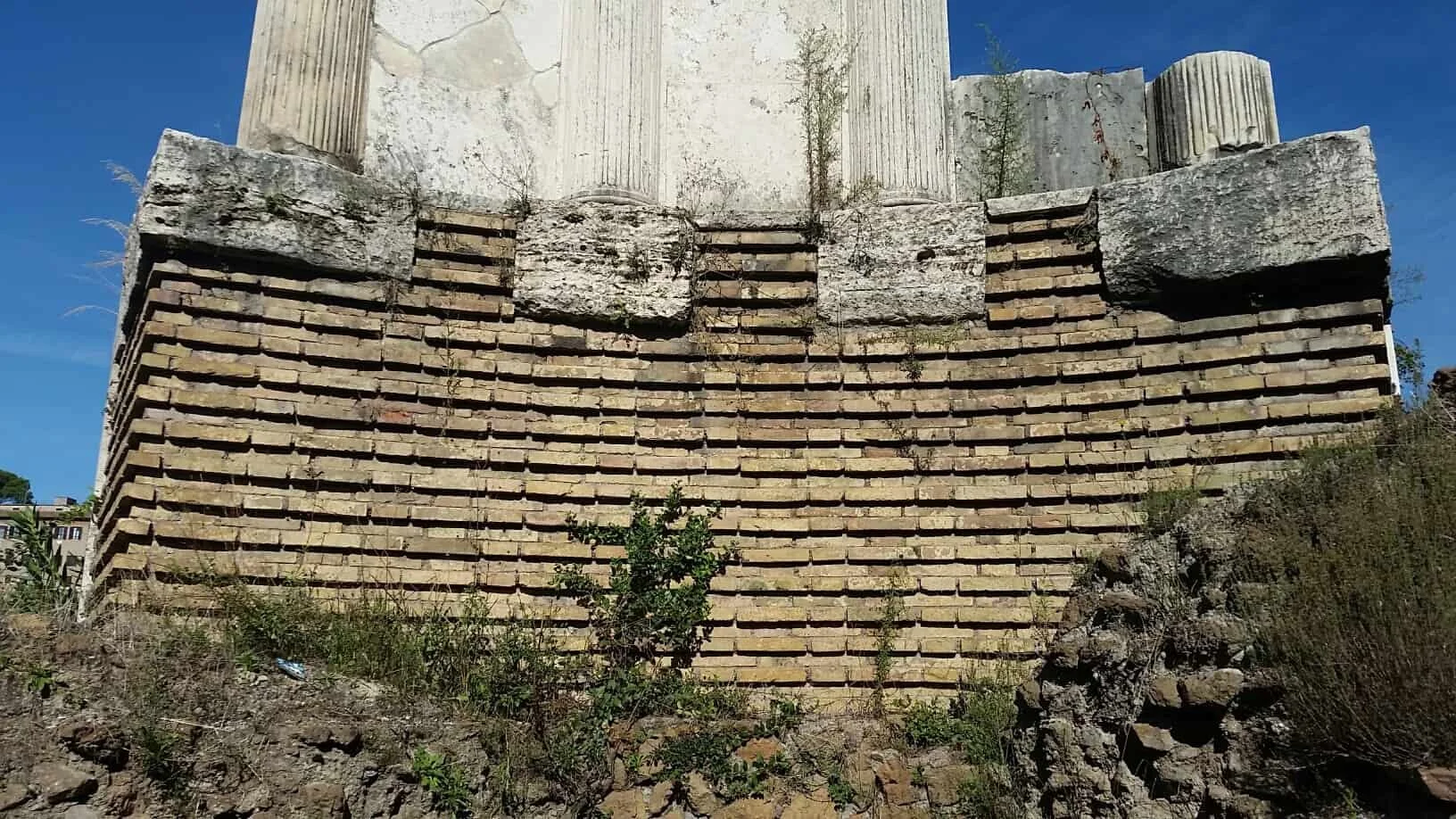
Much of the surviving concrete foundation and podium beneath the temple in the Forum today has been dated to this Augustan phase, meaning that even though later fires destroyed the superstructure, the base that Augustus built has, remarkably, endured beneath everything that came after. And if you’ll permit me a fanciful twirl, I think there’s something quite poetic about that. Augustus built so many “foundations” that we, in our culture and society, still build upon.
In any case, coins minted under Augustus, and again later under Tiberius, depict a round structure with a conical bronze roof standing on a three-stepped base with Ionic-capital columns. This numismatic evidence plays an important role in reconstructing what the temple looked like during this important period in history and religion.
Phase six: the Great Fire of Rome under Nero, 64 CE
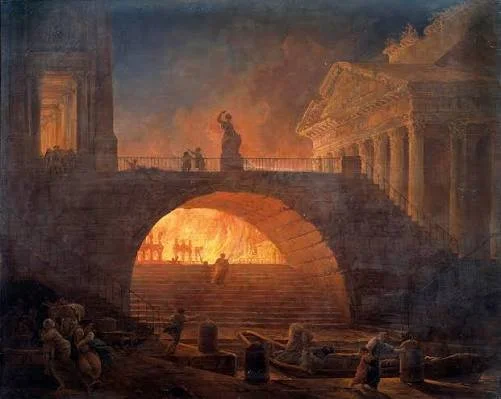
When the Great Fire of Rome tore through the caput mundi, it devastated the entire Vesta precinct — the temple, the house of the Vestals and the Regia — burning nearly all three structures to the ground. Almost everything visible in the Atrium Vestae complex above the Augustan-era foundations postdates this disaster.
The temple of Vesta, and its neighboring buildings, were rebuilt under Nero. Further restoration and expansion happened under Domitian and Trajan, with each emperor leaving their own construction fingerprints on a site that had already been rebuilt multiple times over eight centuries.
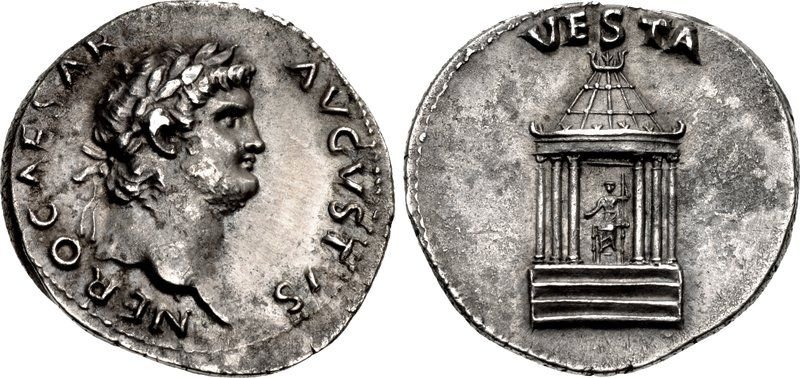
A coin of Nero, showing the emperor and celebrating the restoration of the Temple of Vesta after the great fire. Copyright Classical Numismatic Group.
Phase seven: the Severan restoration, and the temple (ruins) we see today, 191–early 200s CE
During the reign of Commodus, another major fire destroyed the temple. It was the emperor Septimius Severus and especially his wife, the empress Julia Domna, who led the restoration.
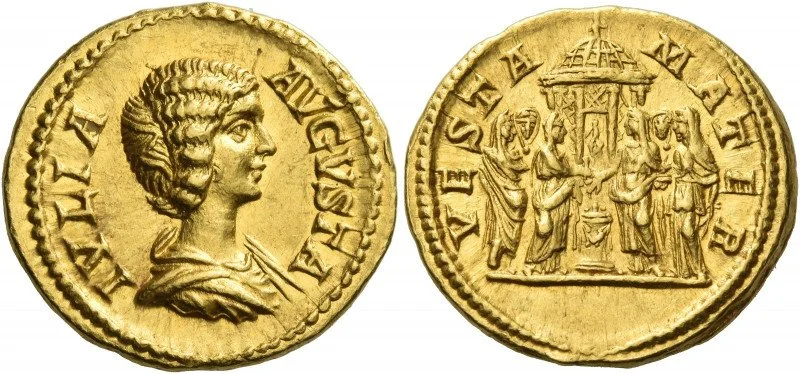
An aureus of the lovely Empress Julia Domna who championed the restoration of Vesta’s temple in the Severan period. This remarkable coin shows the Vestals sacrificing at a lit altar with the temple in the background. Copyright Numismatica Ars Classica.
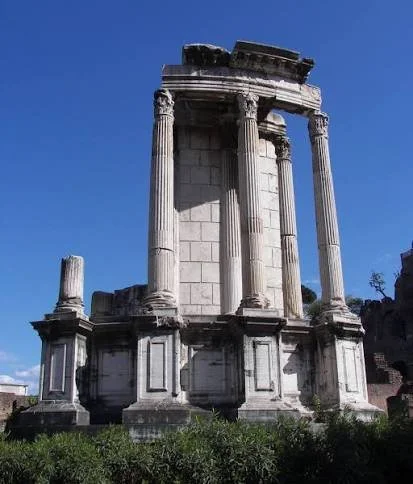
The temple’s visible ruins that we see today — the podium, sections of Corinthian columns, the marble facing — are fragments of Julia Domna’s restored temple. The restored temple stood roughly fifteen meters in diameter, was ringed originally by twenty fluted Corinthian columns on a marble-faced podium, and had a hollow area beneath the cella floor which likely stored the sacred fire’s ashes.
Phase eight: all good things must come to an end, 391–394 CE

In 391 CE, the emperor Theodosius I issued edicts banning pagan sacrifice and closing temples across the empire; further measures around 394 CE effectively ended the Vestal order and extinguished the sacred fire for the last time, after roughly a thousand continuous years of burning.
This is the event and time period in my novel Coelia Concordia: The Last Vestal Virgin of Rome. It was a slow legal strangulation, a creeping loss of rights, followed by a “forced extinguishment” and the closure of a temple with a long and vital history. So you might say the last “destruction” of the temple wasn’t because of fire, but rather oppression.
For some time, the building itself may have been used as a Christian church. But eventually, it fell into physical neglect and decline.
Phase nine: quarried for marble, 1549 CE
For over a millennium after Theodosius, the temple simply crumbled and was scavenged. The most documented single episode of destruction came in 1549, when the site was stripped of its marble to supply building material for Renaissance churches and papal palaces then under construction elsewhere in Rome. It was a common fate for ancient Roman monuments during this period, when the city's classical ruins weren’t seen as cultural heritage but merely handy quarry.
Phase ten: rediscovery, 1877–1902
Modern archaeological interest in the Roman Forum picked up gradually from the late 18th century onward, with early clearance work by figures such as Carlo Fea beginning around 1803.
The Temple of Vesta's remains were substantively uncovered starting in 1877, with more extensive excavation campaigns in 1883 and again in 1899–1902.

Original press photo of the temple ruins after excavation, early 20th century
These early digs recovered the podium and various architectural fragments. However, the record-keeping and interpretation from this period was inferior to modern standards. Material from different centuries could be mixed without distinguishing it, and conclusions drawn by early archaeologists were often speculative and yet accepted without question or challenge.
Phase eleven: Van Deman brings order to the evidence, 1906–1909
The single most important early and perhaps truly scientific study of the site came from the American archaeologist Esther Boise Van Deman, who diligently observed the ongoing excavation of the House of the Vestal Virgins from 1900.
Her landmark 1909 work, The Atrium Vestae, published by the Carnegie Institution, was the first study to meticulously separate the site's construction phases by analyzing the concrete and brickwork technique layer by layer. It was a method that this important archaeologist pioneered, and that became standard practice across Roman archaeology afterward. It was Van Deman's stratigraphic analysis of the podium's four distinct concrete strata that allowed scholars to finally and confidently distinguish the Augustan foundation from the later Severan restoration, thus superseding the more impressionistic conclusions or speculations of the 19th-century excavators… who, let’s cut them some slack, were doing their best.
Phase twelve: Giacomo Boni and the twentieth-century Forum, 1898–1925
The broader clearance of the Roman Forum as we recognize it today was largely the work of Boni. So the fact that the ground level is lowered back to its ancient surface, that the major buildings have been liberated from centuries of medieval and Renaissance buildup, that’s pretty much all him. He directed excavations from 1898 until his death in 1925. Boni's team uncovered an amazing array of structures, including the Temple of Vesta, the House of the Vestal Virgins, the Comitium, the Lapis Niger, the Regia, an archaic necropolis, and the spring of Juturna.
Boni’s successor, a chap by the name of Alfonso Bartoli, took over direction of the site afterward. In 1930, he undertook the partial reconstruction that gives the temple ruins their recognizable silhouette today: three (and part of a fourth) standing Corinthian columns re-erected on the ancient podium using fragments recovered from the site. All of it was arranged according to the coin and relief evidence with respect to the Severan temple, the one that Julia Domna restored. Of course, these columns are unlikely to stand in precisely the same arrangement as they did in the empress’s day. They are ultimately a reconstruction, assembled from true ancient material but re-erected to help us visualize the temple as it last stood.
Phase thirteen: modern scientific excavation, 1987–1996 and beyond
Right around the time that you (or your parents) were listening to Depeche Mode and Oasis, the archaeologist Russell T. Scott was leading a diligent re-excavation of the "Area Sacra of Vesta.” He and his team compiled what remains the most authoritative modern chronology of the area’s building history. He also corrected errors that had crept into the record across nearly a century of prior digging.
Like time itself, archaeological science marches on. For example, a more recent study of the Atrium Vestae used physical and chemical analysis of the building materials to trace the technological evolution of Roman concrete and mortar across the site's imperial-era construction phases. This provides information and evidence that complements, and sometimes refines, the older stylistic dating methods pioneered by Van Deman (remember those bricks she was so fascinated by in the early 1900’s).
The Regia, a building so close and so intimately connected to Vesta’s temple, has also remained an active subject of archaeological reassessment.
This is a nice reminder that this relatively small corner of the Forum, which factored so immensely into the history of Rome since its very earliest days, is still a source not just of study, but of love and fascination.
Why this matters to me as a novelist
When I describe a Vestal walking past the Regia on her way to the temple, I want the paving stones and the column style to be as accurate as the sources allow. Sure, that’s partly for world-building, but I also do it out of respect for those structures - as well as those who built them and used them - that were so foundational to our Western culture and civilization. I’ve been privileged enough to participate in scientific research excursions myself in the area sacred to Vesta, and that’s definitely something that has contributed to both my writing and my affection for this subject.
So if you landed on this article after innocently searching “What is the temple of Vesta?” I hope that I’ve helped answer that question. The Temple of Vesta was never just one temple. It was an idea, first built as a wattle-and-daub hut and finally built as a temple of white marble. It makes me think of the movie Gladiator when Marcus Aurelius says, “There was once a dream that was Rome. You could only whisper it. Anymore more than a whisper and it would vanish, it was so fragile.” From fires to intolerance, the temple of Vesta was perhaps a dream in some ways too, though a good one, and one that I hope we never forget.